
Yemen’s Digital Connectivity: Progress, Gaps and the Road Ahead
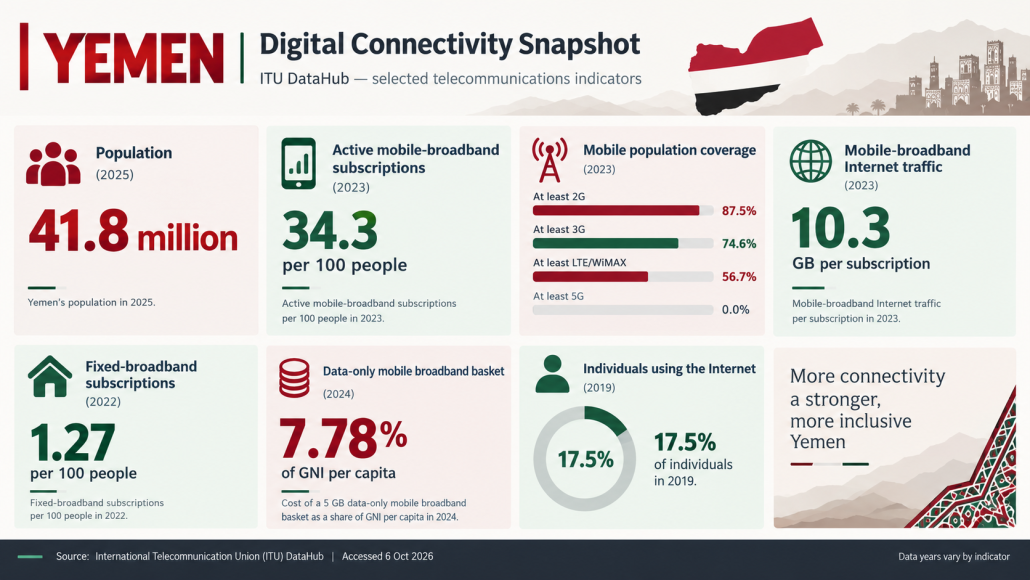
Yemen’s digital landscape is changing, but the country continues to face major challenges in connectivity, broadband access, affordability and digital inclusion. Recent indicators from the International Telecommunication Union (ITU) DataHub provide a useful snapshot of where Yemen stands and where greater investment could make the biggest difference.
[FEATURED IMAGE: Yemen Digital Connectivity Snapshot — ITU DataHub infographic]
Yemen’s digital landscape at a glance
According to the ITU DataHub, Yemen’s population reached approximately 41.8 million in 2025.
The country’s telecommunications sector remains heavily dependent on mobile networks. In 2023, Yemen recorded 34.3 active mobile-broadband subscriptions per 100 people, demonstrating that mobile connectivity is significantly more widespread than fixed broadband.
However, access to the Internet remains much lower than mobile subscription figures might suggest. The ITU reports that 17.5% of individuals in Yemen were using the Internet in 2019, while the latest available household indicator shows 29.6% of households had Internet access at home in 2021.
These figures also highlight an important issue: having access to a mobile network does not necessarily mean having meaningful, affordable and reliable Internet access.
Mobile networks are the backbone of connectivity
Mobile telecommunications are currently the most important connectivity platform for Yemen.
In 2023, mobile population coverage stood at:
- 87.5% for at least 2G
- 74.6% for at least 3G
- 56.7% for at least LTE/WiMAX
- 0% for at least 5G
The figures show that basic mobile coverage reaches a large majority of the population, while higher-speed technologies have considerably lower coverage.
[IMAGE 2: Mobile network coverage in Yemen — 2G, 3G, LTE/WiMAX and 5G infographic]
The gap between basic coverage and advanced broadband coverage is particularly important.
While 87.5% of the population was covered by at least 2G, LTE/WiMAX coverage was only 56.7%. This means millions of people may have some form of mobile network availability but still face limitations when using data-intensive services such as video conferencing, online education, cloud applications and digital public services.
The absence of reported 5G coverage also indicates that Yemen remains at an early stage of the transition towards next-generation mobile networks.
Mobile broadband is growing, but usage remains constrained
Yemen recorded 34.3 active mobile-broadband subscriptions per 100 people in 2023.
This is an important indicator because mobile broadband is likely to remain the primary way many Yemenis access digital services.
Mobile broadband Internet traffic reached 10.3 GB per subscription in 2023.
This demonstrates that mobile networks are not simply providing basic communication services. They are increasingly being used for Internet access, information, entertainment, social media, education, business and other digital activities.
However, subscription numbers should not be interpreted as equivalent to the number of unique Internet users. One individual can have multiple subscriptions, while other people may share devices or connections.
For Yemen, the next stage of digital development therefore needs to focus not only on expanding subscriptions, but also on meaningful connectivity.
Fixed broadband remains a major weakness
Fixed broadband connectivity is considerably less developed.
The ITU reports 1.27 fixed-broadband subscriptions per 100 people in Yemen in 2022. By comparison, the global figure shown by the ITU for 2025 was 20.1 subscriptions per 100 people.
[IMAGE 3: Fixed broadband versus mobile broadband in Yemen]
The difference illustrates the country’s dependence on mobile connectivity.
A strong fixed broadband infrastructure can provide important advantages, particularly for:
- Businesses
- Universities and schools
- Hospitals
- Government institutions
- Research organisations
- Data centres
- Technology companies
- High-bandwidth residential applications
Expanding fibre-optic networks and reliable fixed broadband would therefore complement mobile networks rather than replace them.
Affordability is another critical challenge
Connectivity is meaningful only when people can afford to use it.
The ITU reports that the cost of a 5 GB data-only mobile broadband basket represented 7.78% of GNI per capita in Yemen in 2024.
For lower-income households, the effective burden can be substantially greater than the national average suggests.
[IMAGE 4: Digital affordability in Yemen — illustrating the cost of 5 GB mobile data]
Affordability affects more than social media or entertainment.
When Internet access is expensive, people may reduce their use of:
- Online education
- Telemedicine
- Digital banking
- E-government services
- Remote work
- Online business
- Digital training
- Research and scientific resources
Reducing the cost of connectivity should therefore be considered part of Yemen’s broader economic and social development strategy.
Internet use remains far behind network coverage
One of the most striking aspects of Yemen’s digital indicators is the difference between network coverage and Internet use.
The ITU reports that 17.5% of individuals were using the Internet in 2019.
This is significantly lower than the percentage of the population covered by mobile networks.
The gap suggests that infrastructure alone is not enough.
Internet adoption depends on several interconnected factors:
Infrastructure → affordability → devices → digital skills → relevant content → trust → regular usage
If any part of this chain is weak, the benefits of connectivity can remain limited.
For Yemen, improving digital inclusion therefore requires a coordinated approach rather than focusing exclusively on network deployment.
The digital divide is also an economic issue
Digital connectivity is increasingly linked to economic opportunity.
A well-connected population can participate in:
- Remote employment
- Freelancing
- Software development
- Online commerce
- Digital financial services
- International education
- Research collaboration
- Technology entrepreneurship
For a country such as Yemen, expanding digital connectivity could help overcome some of the geographical and economic barriers that traditionally restrict access to opportunities.
Young people in particular could benefit from greater access to online education, professional training and global digital labour markets.
[IMAGE 5: Young Yemenis using digital technology for education, work and entrepreneurship]
The telecommunications sector should therefore be viewed not only as infrastructure, but also as an enabler of economic development.
Yemen needs investment in resilient telecommunications infrastructure
The country’s telecommunications infrastructure faces an unusually difficult operating environment.
Future investment should prioritise resilience, redundancy and geographic diversity.
Key priorities could include:
1. Expanding fibre-optic infrastructure
Fibre networks can provide high-capacity connectivity for cities, businesses, universities, government institutions and mobile operators.
2. Strengthening mobile networks
Expanding LTE coverage and improving network quality would provide immediate benefits for users who depend primarily on mobile broadband.
3. Developing reliable international connectivity
International bandwidth and gateway resilience are essential for maintaining access to global Internet services.
4. Improving network redundancy
Critical telecommunications infrastructure should have alternative routes and backup systems wherever technically and economically feasible.
5. Preparing for future technologies
Yemen should develop a long-term strategy for technologies including 5G, cloud computing, Internet of Things (IoT), edge computing and advanced fibre networks.
Digital development requires more than infrastructure
Infrastructure is only one part of the solution.
Yemen also needs investment in digital skills and human capital.
Schools, universities, vocational institutions and community programmes can play a major role in developing skills in:
- Computer literacy
- Cybersecurity
- Software development
- Networking
- Cloud computing
- Data science
- Artificial intelligence
- Digital entrepreneurship
- Online safety
A digitally skilled population is better positioned to convert connectivity into employment, education and economic opportunity.
Universities can become digital innovation hubs
Yemen’s universities have an important role to play in the country’s digital transformation.
Improved connectivity can enable universities to participate more actively in:
- International research projects
- Online academic conferences
- Digital libraries
- Open-access research
- Remote laboratories
- International postgraduate programmes
- Artificial intelligence research
- Telecommunications research
- Cybersecurity education
Strengthening academic networks could also support collaboration between Yemeni researchers and institutions around the world.
[IMAGE 6: Yemen university, research and digital innovation concept]
A national research and education network could become an important component of this ecosystem by connecting universities, research centres and educational institutions through high-capacity infrastructure.
Digital inclusion should be a national development priority
The ITU indicators show a clear distinction between coverage and meaningful connectivity.
Yemen has substantial mobile network coverage, but Internet usage, fixed broadband penetration and affordability remain significant challenges.
The policy objective should therefore move beyond simply asking:
“Does the network reach this area?”
The more important questions are:
- Can people afford the service?
- Is the connection reliable?
- Is the speed sufficient?
- Do people have suitable devices?
- Do they have the skills to use digital services?
- Is relevant Arabic content available?
- Can businesses depend on the connection?
- Can schools and universities use it effectively?
These questions define meaningful digital inclusion.
A possible roadmap for Yemen
A practical digital development strategy could be organised around five priorities:
Connectivity
Expand reliable mobile and fixed broadband infrastructure, particularly in underserved areas.
Affordability
Promote competitive and affordable broadband services and reduce barriers to Internet adoption.
Resilience
Strengthen international connectivity, infrastructure redundancy and emergency telecommunications capabilities.
Skills
Invest in digital literacy, technical education, cybersecurity and advanced ICT skills.
Innovation
Create an environment where startups, universities, researchers and technology companies can develop locally relevant digital solutions.
Looking ahead
Yemen’s digital future will depend on the country’s ability to transform basic connectivity into meaningful, affordable and resilient digital access.
The ITU DataHub indicators provide both encouraging signs and clear warnings.
Mobile networks already provide substantial population coverage, and mobile broadband has become an important platform for Internet access. At the same time, fixed broadband penetration remains low, Internet usage data indicate a substantial digital divide, and affordability remains a significant barrier.
The opportunity is significant.
Better telecommunications infrastructure can support education, healthcare, commerce, employment, research, public services and innovation.
For Yemen, digital connectivity should not be viewed simply as a telecommunications objective. It should be treated as part of the country’s wider economic and human-development strategy.
Conclusion
Yemen has the foundations of a digital ecosystem, but substantial work remains.
The next phase should focus on expanding high-quality broadband, improving affordability, strengthening infrastructure resilience and developing the human skills required to use technology effectively.
A more connected Yemen can become a more economically productive, innovative and inclusive Yemen.
Data source
The statistics in this article are based on the International Telecommunication Union (ITU) DataHub – Yemen Digital Development Dashboard.
The ITU DataHub currently reports indicators for different years depending on the dataset. Readers should therefore consider the stated year for each indicator rather than interpreting all figures as representing the same year.
Source: International Telecommunication Union (ITU), ITU DataHub, Yemen Digital Development Dashboard.
Data accessed: 6 October 2026.

Leave a Reply
Want to join the discussion?Feel free to contribute!